

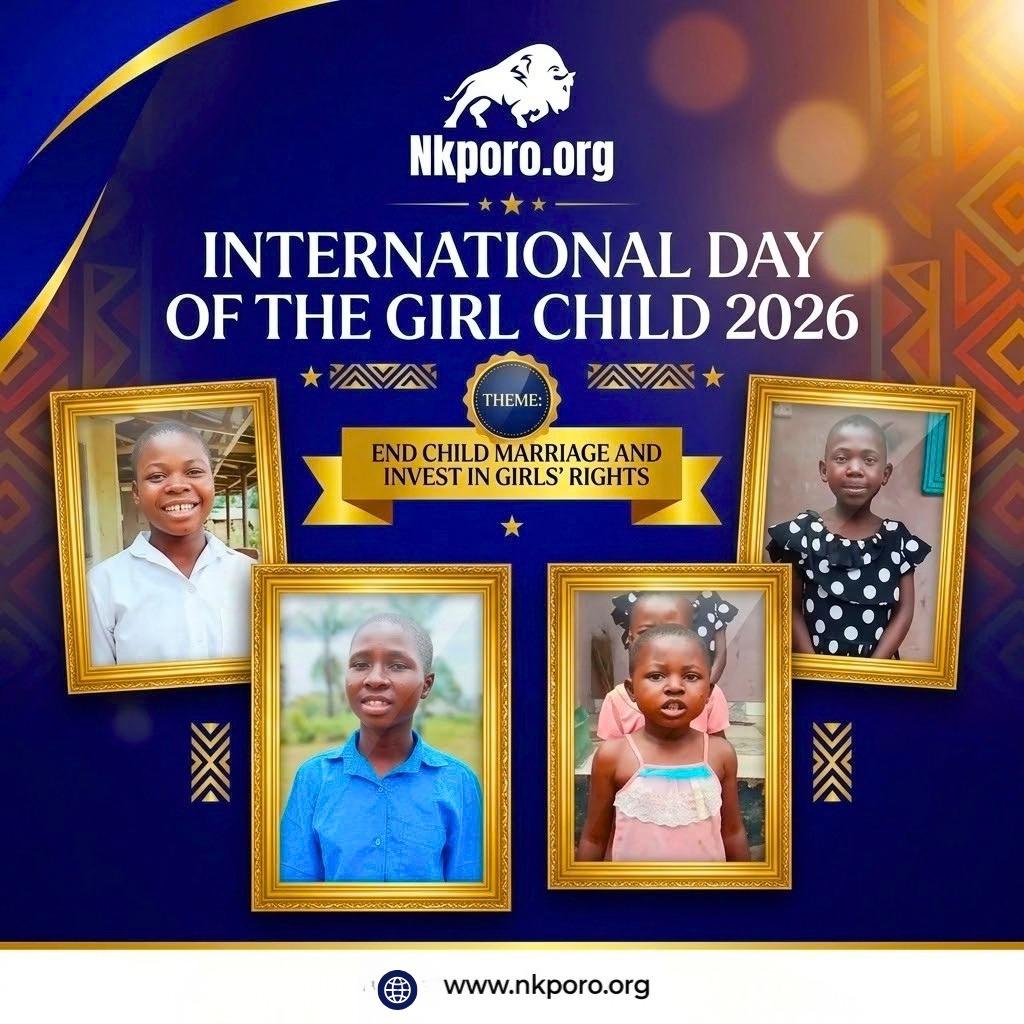
FROM STRENGTH TO WIT: REIMAGINING THE VALUE OF THE GIRL CHILD
I have always identified three distinctive ages in the evolution of how the African girl child has been valued: the age of strength, the age of inheritance and the age of wit.
The age of strength
In predominantly agrarian African societies, physical strength was an important economic asset. Families needed strong hands to clear forests, cultivate land, harvest crops, build houses and protect communities. The boy child was consequently perceived as particularly valuable because he was expected to provide the physical labour required for the survival of the household. The girl child, although indispensable in many aspects of domestic and agricultural production, was often positioned differently within that social structure.
But history teaches us that social values are not fixed. They evolve as societies themselves evolve. With the transformation of African societies came the next age.
The Age of Inheritance
In the age of inheritance, land, houses, businesses, titles and other forms of property became increasingly important markers of family continuity. The question of 'who would inherit what' became central to family life. In many traditional settings, inheritance was organised around the male child. The son was expected to carry the family name, inherit the ancestral property and preserve the lineage. This was the period when the preference for the male child became particularly deeply entrenched.
A family without a son could be perceived as vulnerable to the loss of its name, property and lineage. Consequently, some families continued to have children until a male child was born. The social consequence was profound: the boy became associated not only with physical strength but also with continuity, authority and inheritance.
The girl child, on the other hand, was frequently treated as someone who would eventually leave the family through marriage. Her contributions to the family could be enormous, yet the property and privileges of the family were often not regarded as hers to inherit.
This was not simply a question of individual prejudice. It was embedded in social structures, customary practices and economic arrangements that had developed over generations.
But today, we are in a different age.
The Age of Wit
The age of wit is fundamentally different from the ages of strength and inheritance because wit is not gendered. The world has changed. The economy has changed. The meaning of work has changed. The most valuable resource in contemporary society is increasingly not the strength of the arm but “the power” of the mind “knowledge”, creativity, innovation, communication, critical thinking, technological competence, emotional intelligence and the ability to solve complex problems.
For example, a computer does not ask whether its programmer is male or female. A laboratory does not ask whether its scientist is a boy or a girl. A courtroom does not require a male mind to interpret the law. A university does not reserve intellectual excellence for men. A business idea does not become innovative because it came from a man.
In this age, the question is no longer, “Is this child a boy or a girl?” The more important question is, “What can this child become?”
This is where the African girl child must be reimagined. The girl is no longer merely someone's future wife, someone's daughter, or a temporary member of her father's household. She is a person with intellectual capacity, dreams, creativity, agency and the right to participate fully in shaping the future of the family, community, nation, and continent. And the contemporary African girl is already demonstrating this as she is today found in every sphere of life contributing constructively to development.
Therefore, the recognition of the girl child should not be reduced to ceremonial celebrations, slogans and annual speeches. It must become a social philosophy. We must raise girls who know that their gender is not a limitation on their aspirations. We must also raise boys who understand that the success of a girl does not diminish the worth of a boy. The future should not be constructed as a competition between the sexes, but as a partnership between human beings whose different talents can contribute to the common good.
In summary, the age of strength taught us to value the hand; the age of inheritance taught us to value the lineage; but then, the age of wit challenges us to value the Mind... AND THE MIND HAS NO SEX.
This is my way of saying, "A VERY HAPPY INTERNATIONAL DAY OF THE GIRL CHILD"
Chinyere Otuu Egbuta, PhD.
…………………………………………………………………………………………………………………………………………………………………
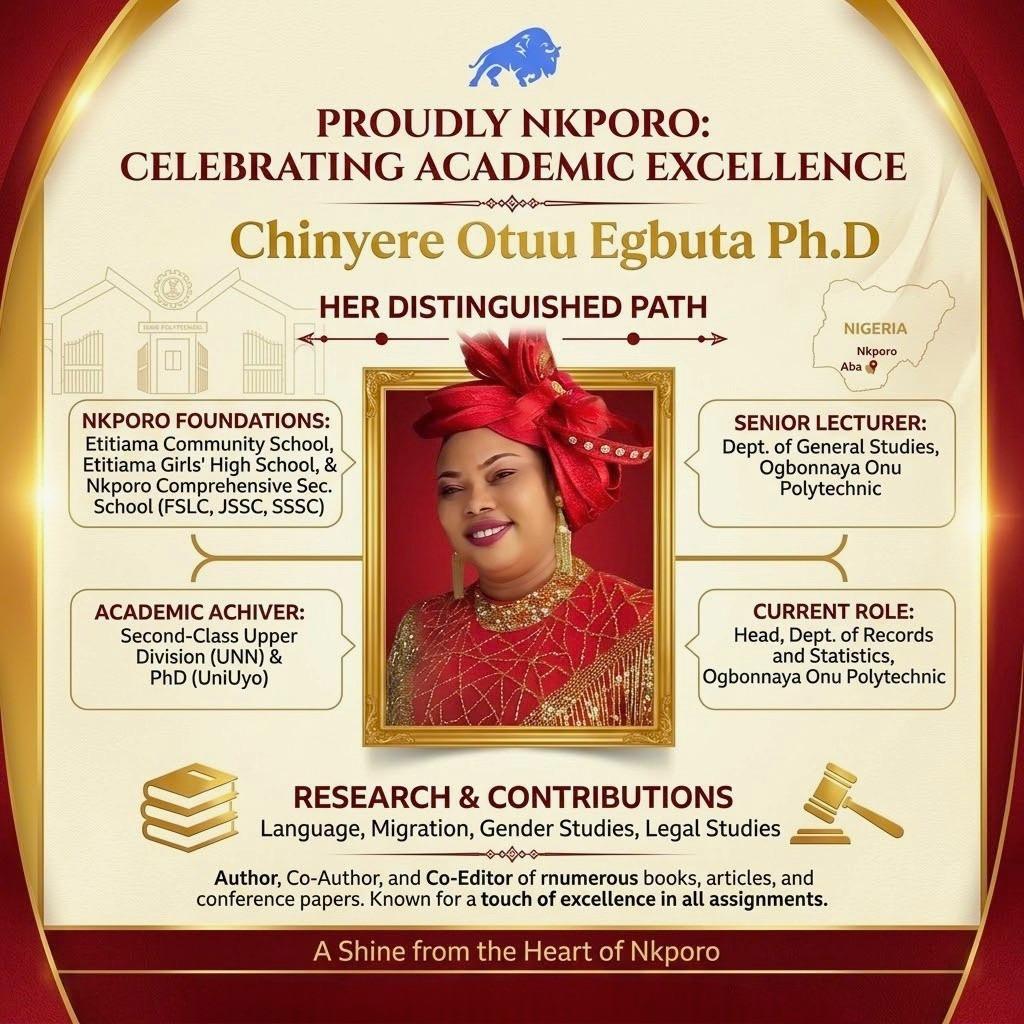
Dr Chinyere Otuu Egbuta is a senior lecturer in the Department of General Studies, Ogbonnaya Onu Polytechnic (formerly Abia State Polytechnic) Aba and currently the Head, Department of Records and Statistics. She had earlier served as the Head, Department of Languages and Communication, as well as the Deputy Director, Centre for Consultancy Services of the same institution. This is in addition to numerous other official assignments she has continued to handle with a touch of excellence.
Dr Egbuta graduated with a second-class (Upper Division) from the University of Nigeria, Nsukka and holds a PhD from the University of Uyo, Akwa Ibom State, Nigeria. Remarkably, she attended Etitiama Community School, Etitiama Girls' High School and Nkporo Comprehensive Secondary School, all in Nkporo, where she obtained her First School Leaving Certificate, Junior Secondary School Certificate and Senior Secondary School Certificate, respectively.
Her research interests are focused on Language, Migration and Gender Studies. Recently she started legal studies. She has authored, co-authored and co-edited many books. Her articles and conference papers have also been published in both national and international journals. Dr Egbuta is very happily married and blessed with lovely children.

Leave a comment
Your email address will not be published. Required fields are marked *